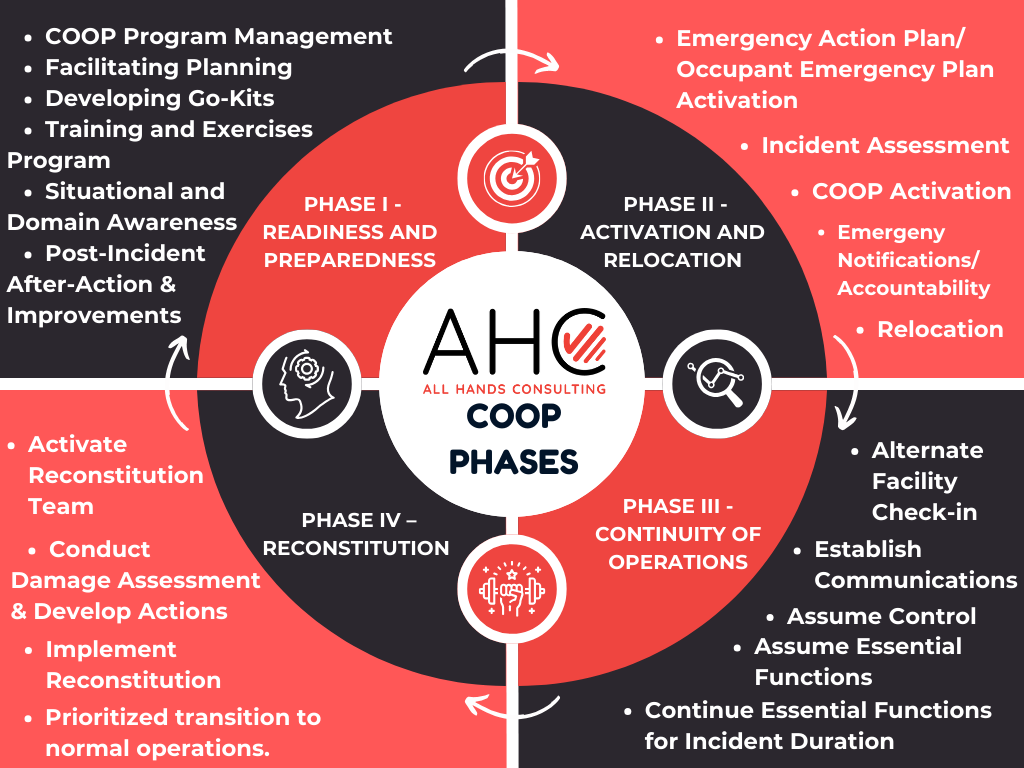

Continuity of Operations / Government
All Hands Continuity of Operations and Continuity of Government services are based on the belief that COOP and COG plans should be developed as part of a Comprehensive Emergency Management Program using a planning process based on federal guidance, industry standards, and best practices in emergency management and continuity planning.
COOP and COG plans should detail all of the procedures that define how a government and the community will continue or recover its minimum essential functions in the event of a disaster.
Essential functions are generally understood to mean those functions that must be performed to achieve the jurisdiction’s critical missions. Each jurisdiction must inventory and prioritize all of its functions and determine which ones are truly essential. Specific plans must then be developed and resourced to ensure continuity of each function. Managers will use these plans to ensure that there is minimum disruption to their service delivery in the event of a disaster or other major interruption to services.
Capabilities Assessment
Plans and Procedures
Develop clear, actionable plans and procedures to ensure continuity of essential functions during disruptions.
Essential Functions Defined
Identify and prioritize the critical functions necessary to sustain core missions during emergencies.
Delegations of Authority
Establish clear lines of authority to ensure leadership continuity during disruptions.
Orders of Succession
Define a succession plan to maintain leadership and decision-making without interruption.
Alternate Facilities Identified
Designate backup facilities to ensure operations can continue if primary sites are unavailable.
Communications and Warning
Ensure reliable communication systems and warning protocols to maintain coordination during emergencies.
Protection of Vital Records and Databases
Safeguard critical records and databases to preserve essential information for continuity.
Testing, Training, and Exercises
Conduct regular training, tests, and exercises to validate and strengthen continuity plans.
COOP Implementation
Activate continuity plans quickly and effectively to sustain essential operations during disruptions.
Roles and Responsibilities
Define clear roles and responsibilities to ensure coordinated continuity operations.
Update, Distribution, and Communication of Plan
Maintain, share, and communicate updated continuity plans to keep all stakeholders informed.
Hazard Identification and Risk Assessment
Identify hazards and assess risks to guide effective continuity planning.
Mitigation and Countermeasures
Implement strategies and countermeasures to reduce risks and minimize potential impacts.
Logistics
Coordinate resources, facilities, and support systems to sustain continuity operations.
Command and Control
Establish leadership and decision-making structures to direct continuity operations effectively.
Assessment Purpose
A COOP Assessment should be conducted to assess operational capabilities and to identify gaps and support a strategic planning process. The assessment should be designed to serve as a basis for actions that need to be taken in order to strengthen the COOP program. The assessment results will assist a local government in establishing priorities and analyzing program performance to improve the quality of the program.
COOP and COG Planning
Our COOP and COG services focus on the jurisdiction’s ability to perform minimum essential government functions during any situation.


COOP plans should be constructed as part of a complete community emergency management program, and as such, should be included in a Comprehensive Emergency Management Program (CEMP) process, which utilizes an “all hazards” approach and addresses the four phases of emergency management (mitigation, preparedness, response and recovery.) COOP programs build upon existing programs for critical infrastructure protection, business continuity, and (computer) disaster recovery planning.
COOP, and COG plans must be tightly integrated. Together, as part of a CEMP, COOP and COG planning will ensure essential community services in the face of any threat. An integrated COOP and CEMP approach should leverage these existing programs and include all essential government operations as well as those essential functions performed by community-based organizations.
All Hands consultants are experienced in both continuity or operations and comprehensive emergency management. We are uniquely qualified to provide COOP and COG planning services.