

Emergency Operations Center (EOC) Review
All Hands Emergency Management Consulting provides Emergency Operation Center (EOC) Review and EOC Vulnerability and Capability Assessment services. We will review your existing EOC and help you improve it both physically and operationally including development of your EOC organization, writing your Operations Manual, and developing Staff Action Guides for each EOC Position. We will also help you with training, software selection and EOC design services.

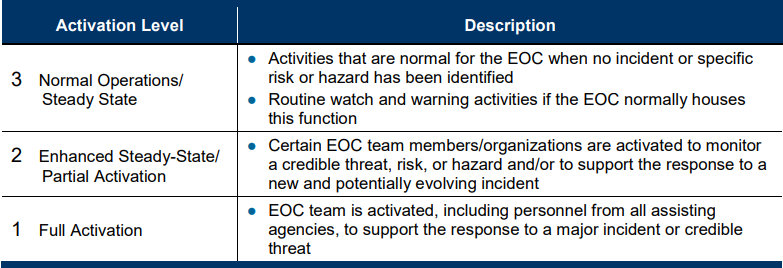
EOC Review Description
We will provide an analysis of the current facility using a comprehensive “best practices” evaluation tool that has been distilled from federal guidelines, FEMA’s capability assessment for readiness (CAR), relevant portions of the NFPA 1600 (emergency management standard), state-of-the-art technologies, and case studies. Existing equipment, space, layout, displays, staffing, procedures will be reviewed. We will provide a gap analysis and make recommendations for improvements.
The report will provide an analysis of the current facility based on federal guidelines. Existing equipment, space, layout, displays, staffing, procedures are reviewed and shortfalls and improvements needed are indicated. All Hands will develop a program profile describing the current status of the program. The report will identify program areas needing immediate development, updating, or improvement, and those elements to be accomplished during the strategic planning period.
Staff and budget requirements will also be indicated. The report will include a “work load analysis” and will document the current services and programs provided by the existing staff. The review report will be based on the following outline.
Review Report Outline
A clear report outline ensures structured and efficient analysis of the incident. It highlights key areas such as causes, impacts, and corrective actions. This organized approach improves communication and accountability.
Part I – The Physical Facility
Location, Background / History
External Structure
Internal Structure
Space Requirements for Personnel to Operate
EOC Layout / Floor plan
Use of EOC Space
Communications and Warning Equipment
EOC Display Equipment
Furnishings, Furniture, Office Equipment, Supplies
Sanitary Facilities, Equipment, Supplies
Food and Water Supply
Kitchen Equipment, Supplies
Sleeping Accommodations
Medical Equipment, Supplies
Janitorial Services, Supplies
Maintenance and Spare Parts
Special Equipment, Clothing
Ability to Deal with Future Technologies
Alternate EOC
Part II – Managing EOC Operations
Defining EOC Functions
EOC Organization Chart
EOC Staffing; EOC Information Handling System, Procedures
EOC Log and Record Keeping System
Crisis Action Team / Duty Officer System
EOC Demobilization / Deactivation
EOC SOPs / Job Aids
EOC Staff Action Guides
EOC Data and Display
EOC Training, Exercises, Drills
EOC Resource Deployment and Monitoring
Communications / Warning
Budget, Operating Costs, Financial
Equipment / Supplies Checklist
Implementation
All Hands staff will be deployed on-site to thoroughly review the physical facility and assess its emergency preparedness. This includes evaluating structural safety, accessibility, equipment readiness, and overall risk exposure. Our team will conduct in-depth interviews with key emergency management personnel to understand current protocols, challenges, and response capabilities. Observations and insights gathered during these interviews will be carefully documented. We will then compile and analyze the data to identify strengths, gaps, and opportunities for improvement.
Sample EOC Review Questions
What additions to the normal EOC staff should be made given the potentials?
To effectively address potential risks and enhance emergency response, the following additions to the normal Emergency Operations Center (EOC) staff should be considered:
Public Health Representative – To address medical concerns, disease outbreaks, or health advisories, especially during pandemics or hazardous material incidents.
Cybersecurity Specialist – With growing digital threats, a cyber expert can help assess and respond to cyber incidents that may impact critical infrastructure or communication.
Logistics Coordinator – Dedicated personnel to manage supply chains, resource requests, and distribution during large-scale or prolonged events.
Public Information Officer (PIO) – To ensure timely, accurate, and unified messaging across all platforms to the public and media.
Liaison Officers – Additional liaisons for utilities, transportation, healthcare facilities, or neighboring jurisdictions to ensure interagency coordination.
Behavioral Health Specialist – To provide mental health support for responders and affected populations, especially in high-stress or traumatic events.
Environmental Specialist – For incidents involving hazardous materials, natural disasters, or impacts to air/water quality.
Legal Advisor – To ensure all actions comply with local, state, and federal laws, particularly during declarations of emergency or resource requisitions.
Should EOC staff be immunized in advance and periodically for anything?
EOC personnel may be exposed to infectious diseases during certain emergencies (e.g., pandemics, bioterrorism events, natural disasters involving unsanitary conditions). Immunization helps ensure staff can continue to operate safely and effectively during critical response periods.
Recommended Immunizations May Include:
Influenza (Annual): Reduces the risk of seasonal flu outbreaks among staff.
COVID-19: As recommended by public health guidelines, including boosters.
Hepatitis A and B: Especially important for those potentially exposed to contaminated water or bodily fluids.
Tetanus, Diphtheria, and Pertussis (Tdap): Useful for staff working around debris or in unsanitary conditions.
Rabies (pre-exposure): For those with potential exposure to animals or wildlife during field operations.
Other Vaccines: Based on specific threats (e.g., smallpox, anthrax) if part of a bioterrorism preparedness plan.
Should special arrangements be made to shower down and re-clothe anyone reporting for EOC duty after an event has taken place depending on the type of event?
Yes, special arrangements should be made to shower down and re-clothe anyone reporting for EOC duty after an event, depending on the nature of the incident. This is especially important in situations involving hazardous materials, biological agents, or radiological exposure. Contaminants on clothing or skin can pose serious health risks and may compromise the safety and functionality of the Emergency Operations Center.
Implementing decontamination procedures helps prevent the spread of harmful substances, protects critical operations, and ensures the health and safety of all personnel. These measures may include setting up mobile decontamination units, providing clean clothing and personal protective equipment, and conducting medical evaluations if exposure is suspected. Proper training and planning are essential to ensure these protocols are followed effectively when needed.
What rules should be in place for entering or leaving an EOC after an event?
Rules for entering or leaving an Emergency Operations Center (EOC) after an event should focus on maintaining security, safety, and operational efficiency. These rules help prevent contamination, ensure accountability, and support continuous operations during a critical response.
Access should be restricted to authorized personnel only, with sign-in/sign-out procedures to track movement. All staff entering the EOC should undergo a health and safety screening, especially if the event involved hazardous materials, biological threats, or potential contamination. Decontamination procedures may be required before entry.
Personal belongings should be minimized or sanitized, and clean clothing or PPE may be mandatory. Once inside, movement in and out of the EOC should be limited to reduce risk and maintain situational focus. Communication protocols should also be in place so staff exiting the EOC properly transfer duties and provide situational updates